Showing posts with label Book Review. Show all posts

Friday, April 25, 2014

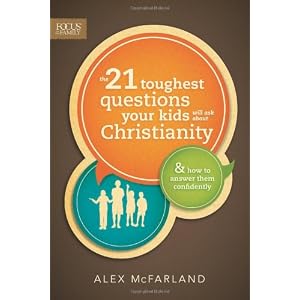
21 Toughest Questions Your Kids Will Ask- Book Review

I have two daughters, who are 7 and 4. So, when I first saw the title of Alex McFarland’s book, the 21 toughest questions your kids will ask about Christianity, I thought it would be good since I would be entering in the next few years the realm of the difficult questions.

The questions that McFarland answers include ones about God the Father, Jesus, the Church, the Trinity and the Bible. The breath of the subjects cause some concern about the content. These are some heavy-duty questions. He starts off the book with why God allows evil and suffering.

Of course, he is only able to give thumbnail sketches dealing with some of these topics, but the answers he gives are not simply the usual bumper sticker type answers we get from some in American evangelicalism. Also, unlike some “Christian” books, he uses the Bible throughout each chapter to ground his answers in the only way that truly matters.

The answers he provides will be an encouragement to the parent, youth leader and young adult who reads them. I can highly recommend this book for anyone who deals with teens or even for those who would like some solid reasons, using logic and Scripture (yes, those do go together). This would be a good starter book for someone new in the faith or to the study of apologetics.


I was given this book from Tyndale Books for free in exchange for an honest review.

DB

Wednesday, March 12, 2014

Book Review: This Beautiful Mess


I had some concerns with this book as I read it. It is not that it is a bad book. I really get the sense of Rick’s heart in this book. He certainly has a pastor’s heart and that comes through pretty clearly. His love for Jesus and others is unquestionable. His desire to draw folks back to a proper understanding of the Kingdom of God is a good one.

However, it is in the execution that, I think, McKinley falls a little short. Many of the topics and chapters had promise and he often made good points, but a lot of the book left me still unclear on some of the topics. I would have liked to see McKinley start the book with Appendix 1 because it gave some more grounding to what he was trying to do. He talked about how we have the idea of “kingdom” wrong, but it wasn’t always clear what that meant.

Now, part of my problem was that I did not know when the Bible verses ended and his thoughts began and vice versa, since he had no (or very few) chapter and verse references for the reader to check back with. Some are included in the notes, but there is nothing in the text of the book that tells me which note it is. This was a big issue because to get a proper understanding, we ought to be continually going back to the Biblical text.

Many of his thoughts and assertions also lacked Biblical foundation. McKinley would make claims and not have a reference to what verse, if any, this was pulled from. It was almost as if he thoughts the Bible verses would ruin the look or flow of the book. This caused me to be more distracted than I would like. It seems it would have been easy enough to include them.

Another problem I had was that there often seemed to be many stories about himself, his church, or his friends. Now, I understand this is to be included, but it seemed like a lot of self congratulations about how he or his church are doing this correctly, not like other folks.

I know some of this seems like nitpicking, and if they were isolated incidents, I would not have been bothered. But these issues continued through the book. I feel like this could have been a much stronger book, if it were shortened and tighter connections to the Biblical text were made. It seems like a sermon series that went on a little too long and it seemed like he was grasping for more to write about and it caused me to want to stop reading sooner than I would have liked.

If this is a topic you might like, and have a lot of free time, pick this up. It is a pretty easy read. But I do not recommend this for anyone just curious about the topic and/or someone who wants more content than McKinley delivers. 


I was given this book for free in exchange for an honest review.

Friday, September 13, 2013

Book Review: Jesus Calling

A while back, I posted a review from the White Horse Inn on the book, Jesus Calling by Sarah Young. Mike Horton discussed the method and the message Young used to supposedly communicate, as Jesus, words for today.

Pastor Bob DeWaay offers his concerns with the some of the message of the book and he tries to show that there are some similarities between the message of Jesus Calling and Eckhart Tolle's writings. He concludes:
Jesus Calling is not "devotion" as expressed in Acts 2:42. Young's romantic panentheism has far more in common with various New Age philosophies than "the apostle's teaching." Christ and His apostles never taught us to become "aware of Presence" so that we can experience metaphysical impressions from the spirit world. This is not the "Jesus Christ come in the flesh" which the apostle John made the key to discernment.
Such a book could only become a huge best-seller in an age of apostasy. It could only prosper where sola scriptura has been abandoned for pious feelings. We live in such a day. We must return to the true teachings of Christ and His apostles for our devotion and lay aside voices from the spirit world, accompanied by metaphysical sensations assumed to be God or Jesus. We do not know what God sounds or feels like. We do know what God has said and are morally obligated to handle His Word with care and respect. Jesus Calling does not and this is not what Christian devotion is all about. That is why I call it "toxic."

At the very least, it seems, we ought to strive to be more discerning in our reading. Sadly, this even extends to things we get from the Christian book sections. Read the rest of the review here.

Friday, July 12, 2013

The Circle Maker- Book Review

Tim Challies is always thoughtful in his book reviews. He is generally fair in representing what the book is trying to communicate, whether purposefully or not, and he offers his critique of this book and its ideas. Be sure to read the review.

The Circle Maker

The Circle MakerI didn't know what The Circle Maker was about until I began to read it. Neither did I know anything about Mark Batterson, its author. I knew the book only as a Christian bestseller and its author only as a name that often appears in my inbox as people ask if I know anything about him or have read his books. "My pastor gave everyone in the church a copy of this book. Have you reviewed it?" Finally I read it.
Mark Batterson is lead pastor of National Community Church in Washington, D.C., a church regarded as one of the most innovative and influential in the country. He made his debut in Christian publishing with In a Pit with a Lion on a Snowy Day and followed that up with several other titles, including The Circle Maker.
The Circle Maker finds its title and inspiration in Honi Ha-Ma’agel, a Jewish scholar who lived in the first century B.C. and who is described in the Talmud. He is remembered as a miracle-worker in the tradition of Elijah and Elisha. Wikipedia provides a condensed version of his most famous miracle:
On one occasion when God did not send rain well into the winter (in the geographic regions of Israel, it rains mainly in the winter), he drew a circle in the dust, stood inside it, and informed God that he would not move until it rained. When it began to drizzle, Honi told God that he was not satisfied and expected more rain; it then began to pour. He explained that he wanted a calm rain, at which point the rain calmed to a normal rain.
Batterson says, "The prayer that saved a generation was deemed one of the most significant prayers in the history of Israel. The circle he drew in the sand became a sacred symbol. And the legend of Honi the circle maker stands forever as a testament to the power of a single prayer to change the course of history." From Honi he has learned the value of big, bold, audacious prayers. On a very practical level, he has learned the value of drawing figurative (and sometimes literal) circles. The promise of his book is that it "will show you how to claim God-given promises, pursue God-sized dreams, and seize God-ordained opportunities. You'll learn how to draw prayer circles around your family, your job, your problems, and your goals."
The book has been widely-praised and has received hundreds of positive reviews, but surely people have simply failed to understand that Batterson has committed a grave error. He begins with Honi, an character who appears in books that are not (and have never been) regarded as inspired by God. He takes Honi as an authentic character who performed an authentic, God-ordained miracle indistinguishable from the characters and miracles of the Bible, and then reads what he learned from Honi back into the Bible. Rather than interpreting Honi through the lens of Scripture, he interprets Scripture through Honi so that from drawing circles he inevitably moves to marching circles and goes to Jericho, asking questions like "What is your Jericho? What promise are you praying around? What miracle are you marching around? What dream does your life revolve around?" He even reads Honi back into church history, looking to Christians of days past and saying that they were drawing Honi-like prayer circles.
The book's examples and illustrations are largely drawn from his own life, from the dreams, goals and desires that he has seen fulfilled. He speaks of drawing a large circle around an area of Washington by walking around it while praying; before long he had a successful and growing church within that circle. He writes about circling a building he wanted for his church, marching around it, laying hands on it, even going barefoot on its holy ground, until it was his. Occasionally he shares examples from others so that he speaks of a friend who desperately wanted to be general manager at a certain golf course; he describes how his friend marched around the club house with his family seven times and then received the desire of his heart.
He anticipates the critique that what he advocates is a kind of "name it, claim it" theology and insists it is not. He says, for example, "Before you write this off as some 'name it, claim it' scheme, let me remind you that God cannot be bribed or blackmailed. God doesn't do miracles to satisfy our selfish whims. God does miracles for one reason and one reason alone: to spell His glory. We just happen to be the beneficiaries." I think he doth protest too much for what he teaches is very nearly indistinguishable. While he may not suggest praying for a bundle of cash or a fancy new car, there is no reason in the book why we would not do this. "I have no idea what your financial situation is, but I do know this. If you give beyond your ability, God will bless you beyond your ability. God wants to bless you thirty-, sixty-, hundredfold." That sounds just too familiar.
When I had finished reading The Circle Maker I found myself reflecting on why a book like this one is so attractive. Why do people love it so much more than a more realistic, biblical book on prayer? What makes it resonate so deeply? Let me share a few suggestions.
First, Batterson describes the Christian life as one of constantly witnessing miracles. He must use the word "miracle" hundreds of times and writes often of all the miracles he has witnessed. I think there are times when every Christian longs to see God work in miraculous ways, yet the challenge for the Christian is simply this: Will you believe God at his Word or will you demand more? Batterson promises miracles, yet as he does this he defines down miracles, making a miracle any answer to prayer. We prayed for a building and got it. Miracle! I needed a bill paid and found money. Miracle! In this way every answer to prayer is a miracle.
Second, he makes direct communication from God the normative experience for the Christian. He speaks often of God whispering to our spirits and encourages Christians to follow inner impressions, what he describes as "the promptings of the Spirit." "Let me spell it out: If you want to see crazy miracles, obey the crazy promptings of the Holy Spirit." I believe that every Christian longs for that unmediated, face-to-face contact with God; and yet again, the challenge for the Christian is whether we will be content with being indwelled by the Holy Spirit who illumines the words of Scripture so that God speaks to us through his Word.
Third, he often takes Scripture far beyond its context which allows him to make promises the Bible does not actually make. He regularly claims Old Testament promises that were clearly meant for a particular people at a particular time as if they were written specifically for him. He looks to Revelation 3:8 and uses it to speak of opened and closed doors as they relate to knowing and doing the will of God. He writes about the spiritual value of the Daniel diet. To be frank, he utterly and consistently butchers Scripture; the Christian reading with an open Bible will soon have to see that so many of Batterson's claims cannot be supported.
Finally, he speaks confidently of things the Bible simply does not say and again, this allows him to claim more than the Bible allows. For example he says, "Sometimes physical contact creates a spiritual conduit. Proximity creates intimacy. Proximity proclaims authority. Drawing a prayer circle is one way of marking territory -- God's territory." He trumpets the value of visualizing what you want as a means to obtaining it: "When you dream, your mind forms a mental image that becomes both a picture of and a map to your destiny. That picture of the future is one dimension of faith, and the way you frame it is by circling it in prayer." The Bible gives us no reason to believe that God consistently relates proximity to power or that there is value in visualization (though you may note that New Age teachers often make both of those claims).
The Circle Maker is a mess. I admire Batterson's desire to pray boldly and love his call to more prayer, better prayer, more audacious prayer. Yet so much of what he teaches is sub-biblical, extra-biblical or just plain unbiblical. With hundreds of good books on prayer available to us there is absolutely no reason to spend as much as one minute or one dime on this one.
Note: If you are looking for good, Bible-based books on prayer, here are some suggestions: 5 Great Books on Prayer.

Tuesday, June 04, 2013

Want Free Books? No Matter How Hard I Tried, This Still Sounds Like Spam

Nathan Busenitz over at The Cripplegate has a great list for bloggers who want to reviews books for free. I am wanting to carve more time out for that sort of thing.


Friday, May 31, 2013

Book Review: Jesus Calling

Michael Horton of the White Horse Inn does a good job of looking at some of the problems with the book, Jesus Calling by Sarah Young. He not only deal with some of the message, but the method that Young used to 'hear from God'.


As far back as you can recall, you’ve started or ended the day with a time of personal meditation on God’s Word and prayer. Only this time, you try something different. You want to hear Jesus speak to you personally. So you take out pen and paper and record the results. As she tells us in her introduction, this is what happened when Sarah Young sought a deeper sense of the presence of Jesus. The result is the daily devotional,Jesus Calling: Enjoying Peace in His Presence (Thomas Nelson, 2004). The book has taken off since it was first published. It now includes a variety of supplements and has even been turned into a NKJV study Bible.
The author states up front that, unlike Scripture, the words she reports from Jesus are not inerrant. Nevertheless, she presents them as first-person speech from Jesus himself. “I knew that God communicated with me through the Bible,” she says, “but I yearned for more.” “Increasingly, I wanted to hear what God had to say to me personally on a given day.” That “more” was “the Presence of Jesus,” something beyond the ordinary means of grace. “So I was ready to begin a new spiritual quest,” beginning with Andrew Murray’s The Secret of the Abiding Presence. After reading God Calling, she relates, “I began to wonder if I, too, could receive messages during my times of communing with God.”
Preparing for an interview today on the topic, I read through Jesus Calling. A few reflections: first touching on the method and then on the message.

The Method

In Romans 10, Paul ties the method of salvation to the message: Just as God has saved us in Christ, apart from our works, he has chosen a method of delivering this gift that puts us on the receiving end. We don’t have to ascend into heaven or descend to the depths to find Christ, according to Scripture. “But what does it say? ‘The word is near you; it is in your mouth and in your heart,’ that is, the word of faith we are proclaiming” (v 8). “So faith comes by hearing and hearing by the word of Christ” (v 17).
Jesus Christ, who rose from the dead, is the Word Incarnate; his speech is the very word of God. Proving his claims by his resurrection from the dead, he also commissioned his apostles as his ambassadors. Their speech in his name is his speech. Furthermore, when that word is proclaimed and read today, it is the very Word of God. Preaching involves teaching and exhortation, but it is more than that; it is Christ himself commanding, absolving, justifying, renewing, sanctifying, and assuring us. Christ could not be closer to you than he is by his Word and Spirit.
Neither Christ nor the Spirit speaks today apart from his Word. It is through the public ministry of preaching and the sacraments that the Holy Spirit unites us to Christ with all of his benefits. When we meditate on Scripture privately or in our family devotions, it is an extension of that public ministry. The preached Word calls us “out of ourselves,” as the Westminster Shorter Catechism puts it, binding us to Christ and therefore to his body. It is not simply a private affair in the garden, alone, whose joy “none other has ever known,” as the Keswick-inspired hymn has it (“In the Garden”). It was this point that separated the churches of the Reformation not only from Rome but from the Anabaptists.
Yet evangelicalism is a river into which various streams converge. The Reformers discovered in Scripture an inseparable connection between the public and the private, the external and the internal, the formal and the informal. However, radical Protestantism has frequently set the latter over the former. Sure, the external Word matters, but it’s the word that Jesus or the Spirit speaks directly to each of us every day that matters more. “Something more” is the essence of what the Reformers called “enthusiasm.”
In terms of method, then, Jesus Calling is a “something more” book. At the very least, I believe that it encourages believers to see God’s Word as hum-drum and to ascend into the heavens or descend to the depths to discover a word that will make Jesus more present in our daily lives. According to the Reformation stream of evangelicalism, God speaks to us in his Word (the arrow pointing down from God to us) and we speak to him in prayer (the arrow directed up to God). However, Jesus Calling confuses the direction of these arrows, blurring the distinction between God’s speech and our response.

The Message

In terms of content, the message is reducible to one point: Trust me more in daily dependence and you’ll enjoy my presence.
There are some good points. Jesus, according to the author, doesn’t promise a problem-free life; trials are opportunities for growth spurts. He’s in charge and works everything together for our good. Don’t seek Jesus merely to confirm your own plans for the day, but be transformed by his purposes. And above all, fix your eyes on Jesus.
Yet I kept asking, “What purposes”? “Who is Jesus and why should I fix my eyes on him?” In short, the gospel is taken for granted. When exhortations to trust are separated from a clear proclamation of who Christ is, what he has done, and why he is therefore trustworthy, trust simply becomes a work—something that I need to gin up within myself.
The substance of the book is drawn from the wells of the Keswick or “higher life/victorious life” movement that B. B. Warfield critiqued so thoroughly at the turn of the twentieth century in his massive study, Perfectionism. Based on the Wesleyan notion of two acts of faith—one for justification and another for sanctification, the Keswick teaching calls believers to enter into the “higher life.” While they are saved, many believers fail to experience the presence of Jesus in their daily lives. By “surrendering all,” letting go of their attachment to the things of this world, and striving to enter into this realm of ultimate peace, believers can attain a perpetual state of victory. As Warfield pointed out, the movement exhibited a deep inner contradiction in its message. On the one hand, you aren’t supposed to do anything, but simply rest in Jesus. Leave off striving! On the other hand, there are many things that you have to strive to do in order to enter into the higher life. Warfield traced the lineage back to Germany mysticism.
Andrew Murray (1828-1917) was a classic spiritual writer in this stream and his book, The Secret of the Abiding Presence, has been a staple of Keswick piety. Murray’s emphases are replete throughout Jesus Calling. The only difference is that they are placed on the lips of Jesus himself.
Compared with the Psalms, for example, Jesus Calling is remarkably shallow. I do not say that with a snarky tone, but with all seriousness. The Psalms first place before us the mighty acts of God and then call us to respond in confession, trust, and thankfulness. But in Jesus Calling I’m repeatedly exhorted to look to Christ, rest in Christ, trust in Christ, to be thankful and long for a deeper sense of his presence, with little that might provoke any of this. Which means that I’m directed not actually to Christ but to my own inner struggle to be more trustful, restful, and thankful.
Consequently, trust becomes a work. Nothing depends on us, but everything depends on us. Strive to stop striving. Then, “Save your best striving for seeking my face” (71). “Thankfulness opens the door to My Presence…I have empowered you to open or close that door” (215). You can achieve the victorious life through living in deep dependence on Me” (6). “Every time you affirm your trust in me, you put a coin into my treasury. Thus you build up equity in preparation for days of trouble. I keep safely in My heart all trust invested in Me, with interest compounded continuously. The more you trust Me, the more I empower you to do so…Store up for yourself treasure in heaven, through placing your trust in Me. This practice will keep you in My Peace.”
The first mention of Christ even dying for our sins appears on February 28 (page 61). The next reference (to wearing Christ’s robe) is August 9 (p. 232). Even the December readings focus on a general presence of Jesus in our hearts and daily lives, without anchoring it in Jesus’s person and work in history.
As in Keswick spirituality more generally, trust becomes an inner virtue that grows by its exercise. “The more you choose to trust Me, the easier it becomes,” Jesus allegedly says. “Thought patterns of trust become etched into your brain.” This has more in common with Aristotle than with the Apostles. The latter taught that faith comes—and is strengthened—by hearing God’s Word proclaimed.
Reading Jesus Calling, I was reminded of the confusing message of my Christian youth. Longing for “something more,” I pored over my mother’s bookshelf: Thomas a Kempis’ Imitation of Christ, D. L. Moody, Bill Bright, and Andrew Murray. Only with the discovery of the Reformers and various Puritan writers was I offered a liberating alternative that drew me out of myself to cling to Christ. While looking to this Reformation stream for a cluster of doctrines, many in the history of pietism have looked for “something more” elsewhere. Luther and Calvin may be great guides on understanding salvation, but we find our spirituality in medieval and modern alternatives. Yet Reformation piety directs us to the Word, always to the Word, where Christ speaks to us every time it is preached and his sacraments are administered in his name. When we come to this Word, in public and in private, we never need something more.

Friday, January 11, 2013

Book Review: Has God Spoken?


The book, Has God Spoken? By Hank Hanegraaff has the subtitle, Proof of the Bible’s Divine Inspiration. The purpose of the book is to provide reasons one can trust the Bible to be the Word of God. To do this, Hanegraaff breaks his book in to four parts or MAPS. Part one deals with “Manuscripts C-O-P-I-E-S”, which deals with how the manuscripts were transmitted and some information on textual criticism. Part two deals with the “Archaeologist S-P-A-D-E”, which gives some of the archaeological evidence used to support the Biblical texts. Part three deals with “Prophetic S-T-A-R-S”, which helps the reader understand the fulfillments of Bible prophecy and part four is “Scripture L-I-G-H-T-S”, which deals with Biblical interpretation, because many misunderstandings can be cleared up by proper interpretation.

Hanegraaff really likes acronyms. Each of the parts is broken down with an acronym that addresses a different line of reasoning. I know that this can be helpful for many folks to remember some of the points and the different lines of reasoning that Hanegraaff offers.

When I got the book, I first noticed its size. It was nearly 400 pages, but then I noticed that about 80 of those pages were in the form of chapter notes, bibliography, and indexes by subject and verse. This turns out to be a good thing, not just because it shortened the length of the book, but also because it added a lot to the extension possibilities for topics to be further investigated.

This is especially helpful because the presentation of information is not done at a high level, that is, Hanegraaff does a good job and making this information accessible to the layperson. Most individual points are only about 10 pages each. Again, this is good because he gives a quick overview of each section versus an in-depth look at the topics. Using the valuable resources in the appendix will help extend the learning for those interested in going deeper.

For anyone interested in a good introductory book that will help you understand the uniqueness of the Bible and reasoning for why we can trust the Bible to be the inspired Word of God, this is a good place to look.

(Disclosure: In exchange for an honest review, Booksneeze had provided me with a complimentary copy of this book.