Showing posts with label Christian apologetics. Show all posts

Friday, April 25, 2014

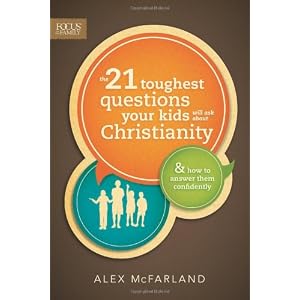
21 Toughest Questions Your Kids Will Ask- Book Review

I have two daughters, who are 7 and 4. So, when I first saw the title of Alex McFarland’s book, the 21 toughest questions your kids will ask about Christianity, I thought it would be good since I would be entering in the next few years the realm of the difficult questions.

The questions that McFarland answers include ones about God the Father, Jesus, the Church, the Trinity and the Bible. The breath of the subjects cause some concern about the content. These are some heavy-duty questions. He starts off the book with why God allows evil and suffering.

Of course, he is only able to give thumbnail sketches dealing with some of these topics, but the answers he gives are not simply the usual bumper sticker type answers we get from some in American evangelicalism. Also, unlike some “Christian” books, he uses the Bible throughout each chapter to ground his answers in the only way that truly matters.

The answers he provides will be an encouragement to the parent, youth leader and young adult who reads them. I can highly recommend this book for anyone who deals with teens or even for those who would like some solid reasons, using logic and Scripture (yes, those do go together). This would be a good starter book for someone new in the faith or to the study of apologetics.


I was given this book from Tyndale Books for free in exchange for an honest review.

DB

Friday, February 28, 2014

Philosophy, Shroud of Turin, and Arizona

Having increasingly become detached from matters of primary importance due to matters of primary importance, so to speak, personally I’ve nothing new to report here.  However, for those who are looking for a quick primer or summary of philosophical matters that are pertinent to apologetics, read here: Triablogue: Parsing perspectivalism.

(Notice that in the section on externalism, knowledge is not defined as mere justified true belief: that classical account of knowledge has since been disproven by Gettier-types of counterexamples, but it serves as a basis for a JTB+ where knowledge is a justified true proposition believed via a reliable process.)

Then again, that the Shroud of Turin is increasingly looking like the real deal--Triablogue: More From Giulio Fanti On Dating The Shroud Of Turin--or that Kirsten Powers (the same one from Fox News?) is a Christian is news to me.  On a parenthetical note, I think that Christians should be very careful, both in word and in deed, regarding the Arizona bill that is currently in the news.  Bear in mind that many of us have jobs and spending habits which already and in effect support evil actions of others, whether it’s management of a chain of drug stores that sell cigarettes, or money sent to cable providers who air MTV and thus help to dumb-down an entire generation of people who already aren’t that bright to begin with, etc.

Monday, February 10, 2014

Apologetics Is Practically a Fifth Wheel, Right?

Consider the Great Commission, with its recursive or perpetual command to future generations of disciples:

Now the eleven disciples went to Galilee, to the mountain to which Jesus had directed them. 17 And when they saw him they worshiped him, but some doubted. 18 And Jesus came and said to them, “All authority in heaven and on earth has been given to me. 19 Go therefore and make disciples of all nations, baptizing them in the name of the Father and of the Son and of the Holy Spirit, 20 teaching them to observe all that I have commanded you. And behold, I am with you always, to the end of the age.” (Matthew 23.16-20, ESV)

Without going as far as to insist that the word “if” (as used below) either expresses or implicates the proposition that something will occur only if such-and-such occurs (we’ve mentioned both Gricean nonconventional implicature and the lesson of John 21.20-24 in the past), think about how likely or unlikely it is that one can be a disciple of Christ without abiding in Christ’s word:

So Jesus said to the Jews who had believed in him, “If you abide in my word, you are truly my disciples, 32 and you will know the truth, and the truth will set you free.” (John 8.31-32, ESV)

Also think about whether certain groups that are nominally Christian at the very least are some who abide in the teaching of Christ—as if JWs or polytheistic Mormons, for example, abide in the teaching of Christ:

Everyone who goes on ahead and does not abide in the teaching of Christ, does not have God. Whoever abides in the teaching has both the Father and the Son. (2 John 1.9, ESV)*

How does one fulfill the Great Commission apart from the education, tutoring or mentoring of new converts to Christianity? What are some possible means through which it is ensured that disciples of Christ remain in the teaching and word of Christ? Is it possible that Trinitarian apologetics has ever been used either of God or of man to keep someone from straying into Arianism or Oneness theology? Is it possible that counter-cultural or counter-cult apologetics have at some moment had the effect of some person’s remaining true to things such as monotheism, the deity of Christ, inconvenient truths about capital punishment or sexual ethics, the reality of hell, and the belief of and trust in what God has said through his prophets and through the apostles of Christ?

These are some things one should think about if he or she as a Christian is ready to put any or all forms of Christian apologetics on the back burner or out to the curb.  Think about it further and you may discover that the various and numerous types of Christian apologetics are comparable to the preaching of the Law and Gospel in the degree to which they are important and have a place in the life of each and every Christian, each person already having his or her own strengths, interests and social connections which in many instances may call for one’s specializing in one of those types of apologetics.
_____________
* Note: practically everyone has “gone ahead” if one will use the phrase in the idiosyncratic manner in which some guy once used the following verse to declare to me that he knew all along, as it were, that I am not a Christian.  After all, and for example, everyone has a naive belief about what biblical personalities looked like: some think that Christ was Black, others thinking he looked like “people from the Middle East,” others having thought of Christ as being White, et cetera: only one group of people here can posses a veridical belief on the matter since it is impossible in any serious sense to speak of someone as being phenotypically both Black and White, for example.

Thursday, October 03, 2013

Loose Ends in the Problem of Evil

I figured that someone would bring animals into the picture at some point and ask why God allows animals to suffer.  I checked, and sure enough others have been thinking the same thing: http://answers.yahoo.com/question/index?qid=20100623113934AAowmvt  Fine then; let’s answer that question.  But first, a preface:

To rescue someone from a burning building is better than to refuse to rescue an innocent person from a burning building.  To rescue someone from a burning building is also better than to do nothing, inasmuch as the word “nothing” is non-referential and any (real) thing is better than something (as it were) that does not exist.  The opportunity to rescue someone from a burning building is better--at least contingently so--than a lack of opportunity to rescue someone from a burning building.

Again, a world in which acts of self-sacrifice, heroism, altruism, mercy and salvation is either contingently or necessarily (I’m speaking conservatively here in using the foregoing disjunction) better than a world in which no one can be saved from a burning building because the latter world is one where there is no danger, there is no element of risk, there is no fear, there is no peril, there is no suffering of any sort, and there is no discomfort of any sort.  Even if ours were a world in which discomfort were minimal, if the teleological ends or goals of this discomfort are acts of goodness and virtue (e.g. Christ’s laying down his life for his people) which exist in addition to acts of the relatively few sorts that would exist in a painless, discomfortless world, then everyone should be able to admit that our world was superior to the painless, discomfortless world.  (I believe I referred to the latter world as “Whoville” in a previous post.)

To save and redeem is better and greater, by definition, than an absence of this.  A world with redemption is greater than a world without it.  Nevertheless, this idea will likely have its naysayers, and someone may ask rhetorically “So why not create a world where evil is never put to an end?  Why not create a world where acts of self-sacrifice, heroism, altruism, mercy and salvation in the face of evil become numerically greater over the course of time?  Why insist, as Christians do, that on some day pain and moral evil will come to an end?”*  In response, and for starters, let’s assume that evil is put to an end according to biblical or Christian doctrine and philosophy.  If one will stop to think about it, couldn’t it be that it is better to have a light at the end of the tunnel and to eventually reach that light at the end of the tunnel than otherwise?  In other words, there is not necessarily much to be said of a world in which people long and yearn for future days when evil and suffering have passed away; however, there is certainly something to be said of a world in which people eventually get this very thing that they have longed for.  It is perfectly plausible that a world in which evil is conquered is better than a world in which either evil will never have been found or evil never ends.

****************

With that said, let’s touch on one last issue as it relates to the problem of moral evil and circumstantial evil.  Christians can appreciate the idea, however rightly or wrongly, that all people have sinned through their forefather Adam** and that sinners qua sinners deserve no favor, protection or gifts from God--if you turn your back on God then you should lie in the bed you’ve made, which means going it alone from now on.  Even children are descendents of Adam and have sinned, so even the suffering of children is something that is believed to be right or just in view of these young people’s moral standing before God.  However, one wonders about the pain and suffering that is experienced in the animal kingdom.  Animals are not believed to be sinners, but the misery that befalls any animal that is hunted down and mauled, strangled or bitten by predators--to say nothing of animals that are abused by humans--is something that does matter; I think everyone can agree on this.***  So the unarticulated thought behind all this is How is it just that God allows animals to suffer?

If we really want a philosophical answer then the answer is found partly in Romans 9.  To which of God’s creations is he indebted?  What does the Creator owe to anyone or anything?  What rights does anyone or anything have that God has not given to them?  If animals are fashioned to play the role that they play in the grand theodical plan to realize the best of all possible worlds, who is anyone to disagree with this?  Notice immediately and in the meantime that all events and affairs on planet earth are observed or known from the heavens.  Where angels themselves do not take notice of things and consider them (Hebrews 1.14; 13.2; 1 Peter 1.10-12), there are three members of the Trinity who know of them and, I would think, will themselves be satisfied with the coming Day in which pain and suffering is experienced by neither human nor animal any longer.  With a view to Isaiah 65.17-25, Lamentations 3.31-39 and Revelation 21-22, it seems clear that everyone on high and on earth would like to see the day when all evil is a thing of the past.  Yet pain and moral evils are those things which make a better tomorrow just as discipline makes a better person or better athlete in spite its inherent discomfort (Hebrews 12.3-11).
_______
* However, it is not clear--to me at least--that evil will ever end as opposed to evil’s simply being marginalized and consigned to that place where people already, according to biblical doctrine, endure everlasting punishment for the wrongs that they have done.  Yes, every knee will bow at the Parousia, but it is not clear to me that the pains and misery of hellfire and utter darkness are enough to stifle the slightest bits of moral wrongdoing which come naturally to people who lived their lives in rebellion against God on account of their fallen nature.
** Again, personally I think that Original Sin makes most sense according to traducianism.
*** For instance, see Numbers 22:21-35 and Proverbs 12:10.

Tuesday, July 30, 2013

Is The Bible Really So "Bigoted" and "Phobic"?

The Bible does not condemn those who merely are sexually attracted to their neighbor’s spouse.  However, what one does with that attraction is what will be the death of him if he makes the evil choice.  Yet the Scriptures are never condemned as being adulterophobic.

The Bible does not condemn those singles who merely are sexually attracted to single members of the opposite sex.  However, what one does with that attraction is what will be the death of him if he makes the wrong choice.  Yet the Scriptures are never condemned as being extramaritalsexphobic.

In fact, the Bible does not condemn those who merely are uninterested in meeting the physical needs or desires of their spouse.  However, if this lack of interest persists as a product of repeated decisions borne of laziness, selfishness or foolishness, then these decisions will be his undoing.  This is one thing that the apostle Paul teaches in 1 Corinthians, chapter seven; yet no one would ever think to condemn the Scriptures as being abstinencephobic.

So may the reader consider this refresher course in biblically-based sexual ethics and the way in which it is worded.  We all need to get back to basics sometimes, as does Desmond Tutu and any number of persons today who in all undue glibness throw certain labels at Christianity or the Scriptures regarding certain social issues.

************

Meanwhile, do not think that what liberal Christianity, as it were, has to say about the issues of the day are unimportant.  Liberals in general tend to think alike, coalesce, move in the same direction of thinking though they be a diverse group.  The Christian theology, again as it were, that attempts to paint a rosy picture of homosexuality is well likened to a viral infection, fifth column or Trojan horse.  First it attacks the Law and the apostles of Christ, because it must.  In the meantime, there remains the problem that recorded in the Gospel accounts is Christ’s acceptance of the authority of the Law even during his own time; accordingly, this becomes the next target as attempts are made to defeat it by glossing over it, lying about it, or writing it off as a matter of interpolation.  And the defeat of the Law, the apostles of Christ, and of the words and teachings of Christ comes at a great price: the destruction of sound practices of exegesis and hermeneutics.

Once the basics and common sense behind normal exegesis and hermeneutics are destroyed, the groundwork is laid for a groundswell of theology or teaching which fits with liberal thought patterns and emotional patterns: Sola Scriptura is effectively lost to false intuition and wishful thinking, the teaching of the everlasting punishment of the damned is lost, hell is reimagined as a condition that exists on this earth, universalism becomes a given, and the idea of divine omnipotence probably isn’t far behind.  Read this post again in fifteen years to see if and how it mirrors events of the day.

Monday, July 22, 2013

Slick’s Apostasy: Various Angles of the Issue

I heard about this first via Alpha & Omega Ministries: Yesterday on the Dividing Line.  I have not yet heard what Dr. White had to say about it, but other people have chimed in in written format, which I can access more easily.

Analysis from the redoubtable Steve Hays: Triablogue: Born to fail.
 
Another from Glenn Peoples (HT: Jason Engwer): How to exploit a family falling out for the sake of ideology.
 
Personally, in my reflections on the whole matter I was thinking more about the specifics of the stated reason for abandoning Christianity.  Without daring to put myself in the company of those commentators I will post those thoughts below, FWIW and as a possible indication of what others might be thinking
 
**************
 
From http://www.patheos.com/blogs/friendlyatheist/2013/07/15/the-atheist-daughter-of-a-notable-christian-apologist-shares-her-story/:

This changed one day during a conversation with my friend Alex. I had a habit of bouncing theological questions off him, and one particular day, I asked him this: If God was absolutely moral, because morality was absolute, and if the nature of “right” and “wrong” surpassed space, time, and existence, and if it was as much a fundamental property of reality as math, then why were some things a sin in the Old Testament but not a sin in the New Testament?

Four thoughts:

1) She was trained by Matt Slick.  Slick is cool, his ministry has stood the test of time, and he is probably one reason that I am a Calvinist today.  However, frankly his work has always been half-baked and over-reaching in some instances, and I fear that when it came to meta-ethics he may have trained his daughter poorly on account of possibly his own not having a solid grasp of certain issues.

2) Do the words “consequentialism” and “context” mean anything to either of the Slicks?  (Of course, I know that at least one of those matters to one of them.)  Or when did the Scriptures ever indicate that virtue ethics, or deontology, or divine command theory were the only possible correct paradigms by which to make sense of God’s law and God’s nature as revealed in the Scriptures?

Yes, Christians are sophisticated enough to reject divine command theory for reasons which are reflected in Euthyphro’s Dilemma.  Yet the Scriptures apparently never rule out consequentialism in toto and never rule out what we might call (gasp) situational ethics of a sort, and the whole of biblical ethics is best understood in considering both virtue ethics and these other ethical paradigms.

When and where is it appropriate in this country to walk around buck naked?  In a classroom at school?  No.  In worship services at church?  No.  At home?  Sure.

When and where is it appropriate to drive on the right side of the road?  In the U.S.?  Yes, but even then not if the driver is drunk and doing 100 mph on a crowded freeway.  In the U.K.?  No, unless suddenly it is good to cause needless head-on collisions with other vehicles.

Are circmstances or possible consequences relevant in the examples listed immediately above?  Yes, and that is exactly why there are exceptions to rules such as those to which we just alluded.

And is the range of permissible moral options dependent on the situation?  Yes, it is.  That is precisely how sex within the bond of marriage is permissible while your spouse’s cheating on you is not, or why harsh punishments are appropriate only for offenders who are culpable of the worst crimes, to cite two examples.

3) At some point the elder Slick may have got tripped up on issues of postmodern ethics or moral TAGs and passed a muddled, incomprehensible message down to his daughter--either that or the younger Slick just failed to grasp what she was being taught.  Similar language or similar terms appear in discussions of each, and this probably was a source of conflation or confusion at some point.

In any case, God is just (even essentially or transcendently so); in translation this means that God’s actions are just, for this is what the word “just” ultimately points to in terms of meaning and function.  Meanwhile, the words “just” and “moral” are more or less synonymous (though I  prefer “just” over the younger Slick’s “moral”), and those words ultimately mean either in accord with some ethical principle or in accord with what is good; and despite that the word “good” has many meanings--all of them dependent on what the metric or standard of measurement is--and despite anyone’s and everyone’s being capable of finding evil things to be favorable--i.e. “good”--or of prescribing evil conduct as though it were something just, God’s actions are just.

God has issued a body of ethical prescriptions and proscriptions of human behavior; each of these commandments are in accordance with both themselves and objective goodness: by definition, they are just.

Moreover, these commandments are “absolute” in the sense--and this is what people mean when they speak of moral rules which are “absolute”--that they are just regardless of whether Smith over here says, “Adultery?  Meh, that’s okay with me; there’s nothing wrong with it” or whether a society over there on the other side of the planet says, “Why not bow down before Baal?  Who else gives us rain for our crops or puts food on our table?”  That is the sense in which they are absolute.

However, this is not to be confused with the issues of divine command theory vs. rival meta-ethical theories.  There aren’t too many Christians who claim that if God suddenly decided one day to proscribe the consumption of turkey dinners then it would be evil to be turkey dinners in virtue of the proscription itself.  No, the claim would more or less be that if a divine proscription of turkey dinners came down the pike tomorrow then: a) it would be because the proscription did not have a favorable timing before then; and b) the proscription is done for a reason which is objectively good; c) rebellion against the Creator is not in accordance with what is objectively good; and d) guess what: God’s nature happens to be one of objective goodness, all such that it was never possible that an intuitively bad thing such as idolatry or sadistic torture or babies would have been prescribed at some point.

“...Why were some things a sin in the Old Testament but not a sin in the New Testament?” she asks.  Answer: if you can find an instance of such things, then stop to reconsider the matter and to ask yourself whether such things promoted the well-being of someone or something at one point in the past but later outlived their ability to do so.  Why is it a sin to issue orders to a someone of the rank of Sergeant First Class in one year whereas ten years later it is not a sin to do so?  Hmm, could it be that someone there in the Army got promoted such that legal and moral privileges which formerly were not theirs later rightly became theirs?  This is one example off the top of my head; you should be capable of doing the same.

4) How old is Rachael Slick again?  Oh yeah, that makes sense.

Thursday, May 30, 2013

A Look into the Possible Future of Christian Apologetics

Consider this quotation (http://triablogue.blogspot.com/2013/05/is-apologetics-failure.html#comment-form)--

I want to underscore one of the points Koukl made, since so many people make the first observation he mentions, but don't follow up on it the way Koukl did. We've had a resurgence of apologetics, but it hasn't kept pace with what's needed. People often say that there's been a resurgence, but don't go on to qualify it the way Koukl did. We ought to go on to ask whether the resurgence has been enough. It hasn't been. Given the changes in technology, increased access to information, changes in political systems, and other factors in place in the modern world, the church needs to be involved in apologetics far more than it has been to this point.
--along with this one (http://religion.blogs.cnn.com/2011/08/11/study-more-educated-tend-to-be-more-religious-by-some-measures/):
«People tend to become less religious as they become more educated, right? Not necessarily, according to a new study.

After analyzing data from a large national survey, University of Nebraska-Lincoln sociologist Philip Schwadel found that people actually tend to become more religious - by some definitions, at least - as they further their education.

“It all falls down to what you consider to be religious,” said Schwadel, an assistant professor at the University of Nebraska-Lincoln. “If it’s simply attending religious services, then no. Highly educated people are not less religious; in fact, they’re more religious.”

“But if it’s saying the Bible is the literal word of God and saying that only one religion is the true religion, then they are less religious,” he continued.

Schwadel used data from the highly regarded General Social Survey, a cumulative and nationally representative survey conducted by the National Opinion Research Center at the University of Chicago biannually since 1972.

Social scientists rely heavily on the “gold standard” General Social Survey, which provides cumulative data collected regularly between 1972 and 2010.

His study will be published in an upcoming edition of the journal Review of Religious Research.

Schwadel found that with each additional year of education:

– The likelihood of attending religious services increased 15%.

– The likelihood of reading the Bible at least occasionally increased by 9%.

– The likelihood of switching to a mainline Protestant denomination - Episcopal, Lutheran, Presbyterian USA or United Methodist - increased by 13%.»

You want erudite and sharp people involved in the apologetics of Christian orthodoxy, because the issues of apologetics have become increasingly fluid and complex.  However, many of those people won’t be signing on to the job when their liberal or errant views of the authority, historicity, and inerrancy of the Scriptures are like those of unbelievers.

Finally, here is one more thing to think about (http://phys.org/news/2011-08-americans-religion.html):

While religious service attendance has decreased for all white Americans since the early 1970s, the rate of decline has been more than twice as high for those without college degrees compared to those who graduated from college, according to new research to be presented at the 106th Annual Meeting of the American Sociological Association.

I think we would be either naive or untruthful to deny that those without college degrees generally are simpler and more gullible than those who have the degrees.  Accordingly, there will likely remain a place in apologetics where Christian apologists need not have an equivalent of an AA in History, Philosophy or Biblical Studies to deal exhaustively with all counter-Christianity arguments that an unbeliever might raise in a dialogue about Christianity.

Wednesday, May 22, 2013

Wednesday Links

In any case anyone missed these entries at Triablogue, here they are:


They will probably come in handy some day, if not now.  Meanwhile, hopefully everyone has been following the news with reports of what has been happening with the IRS and the “Department of Justice.”  Not good news at all….

Saturday, March 30, 2013

Ezekiel

Ezekiel, chapters 40 to 48 are to be taken literally, supposedly: Literally Reading Ezekiel 40-48 | hipandthigh (Cf. Triablogue: Literal events, figurative depictions)

Ezekiel, chapters 38 and 39 are to be taken literally, or are they? Triablogue: Gog and Magog 

If Ezekiel, chapters 38 and 39 are subject to some degree of figurative interpretation, then chapters 40-48 also take a place along the slippery slope. Where, for example, is the very high mountain near Jerusalem? (Riddleblog - The Latest Post - Eschatology Q & A -- What About Ezekiel's Vision of the Temple (Ezekiel 40-48)?

In the process, premillennialism and dispensationalism become questionable; however, by the same token some objections to the apologetical outreach of Messianic Jews also become questionable. For instance, some of the items of Mark S’ list--repeated and re-posed time and again on Yahoo! Answers--hinge on a strict literal interpretation of such passages: Where in the Tanakh do Jews reference when they deny Jesus was the Messiah? - Yahoo! Answers.

And yes, all of the information above is yet another reminder that the world is not a simple place.

Monday, January 14, 2013

Reasons for Christian Apologetics

A reminder of what is at stake when it comes to Christian apologetics and the lack thereof:


Not listed among Slick’s proof texts of the necessity of apologetics are these: 1 Timothy 6.1-2 and Titus 2.9-10.  Semi-Pelagian apologists should especially love these two passages since they apparently are consonant with idea that slick advertising can bring about repentance and faith.  In any case, the two texts apparently support the idea that Christians or Christian teaching should, at worst, be only minimally offensive to unbelievers.

As a side note, and interestingly enough, one may notice that according to those two texts it was particular rejection of slavery that would have been offensive to unbelievers of the time and place in which the apostle Paul lived--the opposite of what critics of Christianity now object to when they charge that Christianity supports chattel slavery.  Of course, if one will make more than a superficial comparison and contrast between Roman-era slavery and modern slavery, then he should discover that motivations and circumstances behind the two institutions are quite different.  That is what they should discover, yet we live in a world where people are lazy and have their own particular agendas, do we not?