Showing posts with label Christian behavior. Show all posts

Monday, February 10, 2014

Apologetics Is Practically a Fifth Wheel, Right?

Consider the Great Commission, with its recursive or perpetual command to future generations of disciples:

Now the eleven disciples went to Galilee, to the mountain to which Jesus had directed them. 17 And when they saw him they worshiped him, but some doubted. 18 And Jesus came and said to them, “All authority in heaven and on earth has been given to me. 19 Go therefore and make disciples of all nations, baptizing them in the name of the Father and of the Son and of the Holy Spirit, 20 teaching them to observe all that I have commanded you. And behold, I am with you always, to the end of the age.” (Matthew 23.16-20, ESV)

Without going as far as to insist that the word “if” (as used below) either expresses or implicates the proposition that something will occur only if such-and-such occurs (we’ve mentioned both Gricean nonconventional implicature and the lesson of John 21.20-24 in the past), think about how likely or unlikely it is that one can be a disciple of Christ without abiding in Christ’s word:

So Jesus said to the Jews who had believed in him, “If you abide in my word, you are truly my disciples, 32 and you will know the truth, and the truth will set you free.” (John 8.31-32, ESV)

Also think about whether certain groups that are nominally Christian at the very least are some who abide in the teaching of Christ—as if JWs or polytheistic Mormons, for example, abide in the teaching of Christ:

Everyone who goes on ahead and does not abide in the teaching of Christ, does not have God. Whoever abides in the teaching has both the Father and the Son. (2 John 1.9, ESV)*

How does one fulfill the Great Commission apart from the education, tutoring or mentoring of new converts to Christianity? What are some possible means through which it is ensured that disciples of Christ remain in the teaching and word of Christ? Is it possible that Trinitarian apologetics has ever been used either of God or of man to keep someone from straying into Arianism or Oneness theology? Is it possible that counter-cultural or counter-cult apologetics have at some moment had the effect of some person’s remaining true to things such as monotheism, the deity of Christ, inconvenient truths about capital punishment or sexual ethics, the reality of hell, and the belief of and trust in what God has said through his prophets and through the apostles of Christ?

These are some things one should think about if he or she as a Christian is ready to put any or all forms of Christian apologetics on the back burner or out to the curb.  Think about it further and you may discover that the various and numerous types of Christian apologetics are comparable to the preaching of the Law and Gospel in the degree to which they are important and have a place in the life of each and every Christian, each person already having his or her own strengths, interests and social connections which in many instances may call for one’s specializing in one of those types of apologetics.
_____________
* Note: practically everyone has “gone ahead” if one will use the phrase in the idiosyncratic manner in which some guy once used the following verse to declare to me that he knew all along, as it were, that I am not a Christian.  After all, and for example, everyone has a naive belief about what biblical personalities looked like: some think that Christ was Black, others thinking he looked like “people from the Middle East,” others having thought of Christ as being White, et cetera: only one group of people here can posses a veridical belief on the matter since it is impossible in any serious sense to speak of someone as being phenotypically both Black and White, for example.

Friday, January 03, 2014

Christian Integrity or Hypocrisy?

Truth be told, as I first began to read this blog post I thought that James White had written it.  Of course, it turns out that I was mistaken and that this was a re-posting of a piece that had more or less been Canerized at a different website.  I would like to comment--and hope to do so as a follow-up piece--but the article itself is enough to think about and chew on for a long time:


By the way, if the careers of the likes of Jimmy Swaggart, Peter Popoff, or Charlton Pearson can survive or be revived after media scandals or dissolution of their ministry, why can’t Caner just fess up, lie low for a while, and wait for his public career to be brought back from the dead?  Oh, wait: somewhere along the line I think I answered my own question.

Thursday, June 13, 2013

Another reason that we lose

Originally I was wanting to post something entirely different yet related to the Southern Baptist Convention just the same.  Chores and fatigue have prevented this for a long time now, but I will make an effort to say the following, however: Christians and social conservatives are not that bright.

We’re not that bright: first in terms of intellect, but now also in terms of positive cultural influence à la Matthew 5.13-16.  The Southern Baptist Convention in 1997 showed that it had heart when it began to fight the Disney empire and just as other Christians began to come up with every conceivable lame “excuse” for supporting the SBC’s boycott of things Disney.  This time around, on the other hand, the same organization which once was capable of noble action against social evils has shown that whatever wisdom it once had may have gone out the door in the natural flow of organizations’ shedding and gaining parts as members join, step down, die, become senile, etc.


The nation's largest Protestant denomination stopped short of calling for its member churches to boycott the Boy Scouts, but voiced strong opposition to acceptance of gay scouts - with a top church leader predicting at the annual gathering of Southern Baptists that a "mass exodus" of youths from the program that has been a rite of passage for more than a century.

The move by the Southern Baptist Convention came at its annual, four-day meeting in Houston, and three weeks after the Boy Scouts of America voted to allow gay youth to join.  With more than two-thirds of Boy Scout troops sponsored by religious organizations, and Baptists being the nation's largest protestant denomination, the resolution could have a crippling effect on the Boy Scouts.

"There will be a mass exodus over time," said Frank Page, president of the Southern Baptist Convention Executive Committee. “Churches are finally going to have to come to realize – there is a point when you say, ‘sorry, no more.’"

Let us juxtapose this with the following snippet from Baptist Press - Page, Land send letters opposing Scout proposal - News with a Christian Perspective posted on 05/17/2013:

"For over a century," Page wrote, "Scouting has helped our youth develop character and leadership skills forever impacting their lives. I am distressed by the recent proposed resolution which would introduce the subject of sex and sexual orientation into the program of the Boy Scouts. For one hundred and three years Scouting has been a safe haven from such topics rightfully reserved for parents. Such an introduction is inconsistent with the principles found in Scouting's sacred Oath and Law."

For starters, if you decimate the Boy Scouts by keeping your children out of it, you have now taken away the said means of developing character and leadership skills in the youth.

Secondly, a person who is openly gay need only be someone who is being honest about what feelings or attractions he has; it is hardly as if everyone who is a homosexual is someone who wears his “identity” on his sleeve or goes about broadcasting his sexual orientation to everyone around him.  Someone who is merely being honest their particular mental disorder--and yes, I will call it that--is not someone who categorically should be denied the opportunity to have character and leadership skills instilled within him.

Thirdly, the “safe haven” objection seems perfectly naive in considering what amount of the U.S. population is homosexual, how many members of that subpopulation would be interested in joining the Boy Scouts, and how many youngers already know that homosexuality exists.  Homosexuality is mentioned time and again in your copy of the Bible, you know.

Fourthly, what will be gained if you take your kids out of the Boy Scouts and attempt to set up conservative alternatives to the Boy Scouts?  Attempts at Christian isolation from the culture tend to create cultural ghettoes, something well-exemplified by CCM, where the only reason untalented people are getting record contracts is to fill a void in a niche market, or Christian cinema where half the movies of that genre would probably end up on Mystery Science Theater 3000 if that show were still on the air.  Sorry, but Christians do not in every instance have all the talent, money and resources necessary to put together a grade A organization or product; attempt a Boy Scouts of America alternative if you must, but please do not bother if only a few people will invest in such a project.

But again, what will be gained if you take your kids out of the Boy Scouts and attempt to set up conservative alternatives to the Boy Scouts?  Do the Scriptures not have something to say about believers’ being “salt and light”?  And do the Scriptures not have something to say about winning people with actions as opposed to mere words?  If there are kids in the BSA who are believers and if there are kids there who are not, then by isolating the believers from the unbelievers an opportunity is missed to show unregenerate people exactly how gracious and selfless a person should be toward his fellow man and how this behavior is borne of an understanding of the teachings of Christ.

Finally, some problems will naturally blow over or fade away if no further fuel is added to the fire.  The sort of attention that some social conservatives don’t want homosexuality and homosexuals to receive is something what would not exist if people would not create news stories by doing exactly the sort of thing for which the Southern Baptist Convention is currently in the news.  In fact, any further legal gains that the Gay Lobby makes could conceivably, over the course of time, come to be as forgotten and ignored as laws of various states which in our own day still outlawed sodomy or adultery.  And despite how debased Western culture has become in its ethically minimalist attitude toward homosexuality, guess what: there are still hate crimes (which I do not condone in any way) being committed against homosexuals, including the recent Madison Square Garden attacks in liberal, home-of-the-Stonewall-Inn New York City.  The point is that people such as members of the SBC need to stop the knee-jerk reactions to cultural occurrences around them and instead calm their nerves so they can think clearly.

Then again, if the reader thinks it is I who am in error here, then my first point is still proven; the fact that people can be disagreeing over the issues means that something has gone wrong somewhere down the line.

**************

Addendum: It is amazing what a little bit of further reading and research can reveal; lo, there may still be hope for Southern Baptist Convention: http://www.reuters.com/article/2013/06/12/us-usa-boyscouts-baptists-idUSBRE95B0NO20130612.  The reaction of the Mormon hierarchy on this issue, meanwhile, is interesting.

Saturday, January 26, 2013

Are Christians Totally Depraved?

Tullian explains what it is is and isn't.
D.

Believe it or not, this is an important question. It’s not simply a theological question. It’s a theological question that has profound practical implications. Our answer will inevitably reveal our understanding of the gospel and reflect our understanding of sin and grace.
First things first: what total depravity isn’t.
Total depravity does not mean “utter depravity.” Utter depravity means that someone is as bad as he/she can possibly be. Thankfully, God’s restraining grace keeps even the worst of us from being utterly depraved. The worst people who have ever lived could’ve been worse. So, don’t read “utter depravity” into “total depravity.”
Well, if total depravity isn’t utter depravity, then what is it? As understood and articulated by theologians for centuries, the idea of “total depravity” means more than one thing.
On the one hand, total depravity affirms that we are all born “dead in our trespasses and sins” (Ephesians 2:1-3; Colossians 2:13), with no spiritual capacity to incline ourselves Godward. We do not come into this world spiritually neutral; we come into this world spiritually dead. Therefore, we need much more than to reach out from our spiritual hospital bed and take medicine that God offers. We need to be raised from death to life. In this sense, total depravity means we are “totally unable” to go to God. We will not because we cannot, and we cannot because we’re dead.
None is righteous, no, not one; no one understands; no one seeks for God. All have turned aside; together they have become worthless; no one does good, not even one. (Romans 3:10-12)
For the mind that is set on the flesh is hostile to God, for it does not submit to God’s law; indeed, it cannot. Those who are in the flesh cannot please God. (Romans 8:7-8)
Salvation only happens when God comes to us.
When the Resurrection and the Life says “Lazarus, come forth”, the rest of the story does not depend on Lazarus. He can drag his feet all the way-admittedly, a hell of a thing to do-but he rises, no matter what. He just plain does… Jesus came to raise the dead. The only qualification for the gift of the Gospel is to be dead. You don’t have to be smart. You don’t have to be good. You don’t have to be wise. You don’t have to be wonderful. You just have to be dead. That’s it. (Robert Capon)
So, in the sense above, Christians are obviously not totally depraved. We who were dead have been made alive.
But God, being rich in mercy, because of the great love with which he loved us, even when we were dead in our trespasses, made us alive together with Christ—by grace you have been saved—and raised us up with him and seated us with him in the heavenly places in Christ Jesus…(Ephesians 2:4-6)
But once God regenerates us by his Spirit, draws us to himself, unites us to Christ, raises us from the dead, and grants us status as adopted sons and daughters, is there any sense in which we can speak of Christian’s being totally depraved?
Yes.
Theologians speak of total depravity, not only in terms of “total inability” to come to God on our own because we’re spiritually dead, but also in terms of sin’s effect: sin corrupts us in the “totality” of our being. Our minds are affected by sin. Our hearts are affected by sin. Our wills are affected by sin. Our bodies are affected by sin. This is at the heart of Paul’s internal struggle that he articulates in Romans 7:
For I do not do what I want, but I do the very thing I hate.
The painful struggle that Paul gives voice to arises from his condition as simul justus et peccator (simultaneously justified and sinful). He has been raised from the dead and is now alive to Christ, but remaining sin continues to plague him at every level and in every way.
Paul’s testimony demonstrates that even after God saves us, there is no part of us that becomes sin free–we remain sinful and imperfect in all of our capacities, in the “totality” of our being. Even after God saves us, our thoughts, words, motives, deeds, and affections need the constant cleansing of Christ’s blood and the forgiveness that comes our way for free. This is what J.C. Ryle was getting at when he wrote, “Even the best things we do have something in them to be pardoned.”
While it is gloriously true for the Christian that there is nowhere Christ has not arrived by his Spirit, it is equally true that there is no part of any Christian in this life that is free of sin. Because of the totality of sins effect, therefore, we never outgrow our need for Christ’s finished work on our behalf–we never graduate beyond our desperate need for Christ’s righteousness and his strong and perfect blood-soaked plea “before the throne of God above.”
The reason this is so important is because we will always be suspicious of grace (“yes grace, but…”) until we realize our desperate need for it. Our dire need for God’s grace doesn’t get smaller after God saves us. In one sense, it actually gets bigger. Christian growth, says the Apostle Peter, is always “growth into grace”, not away from it. Many Christians think that becoming sanctified means that we become stronger and stronger, more and more competent. And although we would never say it this way, we Christian’s sometimes give the impression that sanctification is growth beyond our need for Jesus and his finished work for us: we needed Jesus a lot for justification; we need him less for sanctification.
The truth is, however, that Christian growth and progress involves coming to the realization of just how weak and incompetent we continue to be and how strong and competent Jesus continues to be for us. Spiritual maturity is not marked by our growing, independent fitness. Rather, it’s marked by our growing dependence on Christ’s fitness for us. Because we are daily sinners, we need God’s daily distributions of free grace that come our way as a result of Christ’s finished work. Christian growth involves believing and embracing the fact that, even as a Christian, you’re worse than you think you are but that God’s grace toward you in Christ is much bigger than you could ever imagine.
Because of total depravity, you and I were desperate for God’s grace before we were saved. Because of total depravity, you and I remain desperate for God’s grace even after we’re saved.
Thankfully, though our sin reaches far, God’s grace reaches infinitely farther.

Sunday, January 20, 2013

Lame Arguments Defending Alcohol Consumption

A good look at some of the reasons folks give for 'promoting' Christian liberty in consuming alcohol. There may be a legitimate place for it, but we must be careful not to flaunt the liberty we have, as mature Christian (in particular), to not create stumbling blocks as well. While I have an occasional drink, I do not think it is the best thing for all folks, and even for myself 15-20 years ago...In any case Fred Butler adds some good insight into this discussion.

Lame Arguments the YRR Should Avoid When Defending Alcohol Consumption

Whilst I was on my blog break, John MacArthur, stirred the dander of the 30-something pastor set who love to play like they are sophisticated metropolitans. He wrote an articlebasically telling them to put down their beer steins and wake up to the fact that there is more to Christian liberty than the unshackled, “William Wallace” freedom of drinking imported booze.
I know they were upset with him, because I read a lot of their blog posts and tweets. Not only did the bulk of them entirely miss the point John was making, a number of them would spiral off into left field with some lame arguments they put forth to defend their convictions.
I boiled those arguments down to the four or so lamest ones I encountered repeatedly, and I thought I would highlight them for our educational pleasure.
Before getting to them, however, let me offer some preemptive comments.
I am not a teetotaler. I would never advocate for being a teetotaler. I probably have just as much disdain, if not more, for the legalistic social mores hoisted upon undiscerning Christians by classic American fundamentalists as representing true, Christian virtue as the YRR folks do.
In fact, I like a good wine. I may have a glass if I am on vacation with my wife and we have opportunity to stay at one of those fancy Pacifica hotels dotting the coast of California. We sometimes splurge a little and buy a bottle of Bailey’s around Thanksgiving time that takes us a good couple of months to sip on.
However, I am also aware of the fact that alcohol in any form is viewed by the majority of American Christians as being “sinful.” Yes, I realize they are mistaken about that, but reality is reality, and that attitude is not changing anytime soon, in spite of YRR efforts to the contrary.
As long as beer and wine is perceived as a terrible vice used by party people on spring break, rowdy tailgaters at a football game, and tavern brawlers whose mugshots appear on the “Smoking Gun” website, it is not a wise idea for Christian ministers to promote alcohol consumption among their people.
My life is lived in front of many folks, and it is to those people I am responsible for ministering Christ. Making it a habit to flaunt my liberty with alcohol consumption is not helpful for them, and will only generate more confusion than is necessary.
Now, with that being stated, let’s look at the lame arguments the YRR make to defend their alcohol consumption.
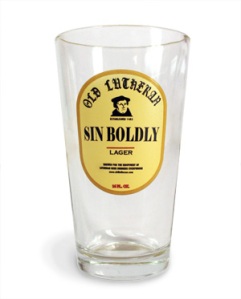
Martin Luther and/or the Reformers and/or the Puritans brewed beer and consumed wine
This is generally the immediate response to my position of cautious moderation. “Well, Martin Luther and/or the Reformers drank beer, so why can’t we?”
Keep in mind that Martin Luther lived 500 YEARS AGO! While we certainly applaud Luther and express our heart-felt Christianly thanks for him defending the timeless truths of the Gospel, that does not mean we are to automatically emulate him, or any other Reformer for that matter, and his various social convictions.
Think about it. What is more important? That we reform ourselves according to biblicalstandards, or historical standards? Honestly, what was a normal part of society in Germany 500 years ago may had been acceptable, but was it necessarily biblical? Even if it is just American Christians who have weird hang-ups with alcohol because of the old prohibition days still doesn’t mean we need to be like German Christians today. It may not be the best use of liberty for them either just because they live in Europe and have no connection to our prohibition past.
The same can be said about the other Reformers as well. Do we adopt all the social conventions of the Reformers and the Puritans just because they did them? Several Reformers practiced astrology, like Phillip Melanchthon. That’s not to say everything Melanchthon wrote stinks of new age mysticism. He was just as much a complex sinner as the rest of us. But his belief in astrology does reflect a common, historic practice among many Protestants during his time. So, who is ready to reclaim horoscopes from the Fundies and reform them for the glory of God?
The more bizarre use of the “Luther drank beer” argument is the appeal to Puritans, who supposedly were quite the bar flies, or at least one would think so according to many of the YRR. But we’re talking about the Puritans. These were the guys who thought wedding rings were popish and outlawed Christmas during Cromwell’s Protectorate. Will we “reform” according to those convictions?
And just a closing word about Mark Driscoll’s absurd claim that a brewery was the first building the Pilgrims built upon arriving in the new world. This is an urban legend. If you and your people are sick and dying and winter is coming on in a strange land, do you waste time building a brewery? Or will it be basic shelter?
obesityFood is abused by way too many people, but you don’t hear Christians crying out about gluttony. Yet there are more people in churches who overeat than there are alcoholics and drunkards, and no one rebukes these brothers and sisters for their reckless overindulgence in food.
The biggest (no pun intended) problem with this argument is that gluttony is not just overeating. It is especially NOT overeating in the sense of a guy eating an entire large pizza in one sitting or scarfing down Chili’s 3,200 calorie “Freakin’ Onion” appetizer all by himself.
Gluttony is always tied to drinking in the Scriptures. What we know to be a drunken, debauched lifestyle. One may say overeating is a part of the debauched lifestyle, but it is the idea of out-of-control, riotous living that makes “gluttony” sinful. This is not super-sizing your McDonald’s order.
Consider Deuteronomy 21:20:
And they shall say to the elders of his city,`This son of ours is stubborn and rebellious; he will not obey our voice; he is a glutton and a drunkard.
If you look at the entire context, you have parents – PARENTS; you know, mama and daddy – bringing their son before the elders to be judged because he is basically a thick-headed good for nothing who spends his time and money (family’s money) on riotous living. The word “glutton” has the idea of a vile, worthless person. Notice what happens with this son. He is brought before the elders of the town so they can pass judgment upon him and if they judge against him, he is stoned to death. That’s the death penalty, folks. He is not executed for being 60 pounds overweight and having lunch at Jack in the Box every other day.
scooterThe health consequences associated with eating recklessly is no joke. Just ask anyone with diabetes. Overeating should be treated just as seriously as alcoholism.
Related to the “gluttony” argument is the “obesity is just as bad if not worse than alcoholism” argument. This one is usually put forth in the combox after a teetotaler lists a bunch of statistics telling how many people die from alcohol related deaths, or how many women and children are abused by alcoholic husbands or parents. As a rebuttal, it’s dogmatically proclaimed that obesity is just as bad if not worse of an epidemic and social problem as alcohol.
This is a profoundly ridiculous comparison. The societal impact of alcoholism and obesity is incomparable. That is because alcoholism has the greatest potential to destroy innocent lives.
Many innocent lives.
In fact, alcohol has destroyed those lives unmercifully. There are no Mother’s Against Obese Driving organizations advocating against 350 pound people driving automobiles. There are no laws against driving under the influence of fried chicken. A cop won’t stop a guy and ask him if he has been eating, and then give him a breathalyzer to test his blood-gravy level. And there is a good reason for this: Obesity only hurts one person. No man, after leaving the Macaroni Grill, has ever gotten into his SUV, and under the influence of the chicken Alfredo platter he consumed 30 minutes before, ran a stop light and killed a family.
Now, just so I am clear. I am not saying obesity is a good thing. Being overweight does have considerable health problems for the individual. AND I would say Christians should make eating healthy a part of their spiritual lives. My point here is not to advocate overeating, but to merely show that obesity is no where near being the societal problem associated with the consumption of alcohol. No where in the ball park. Obesity is a result of bad lifestyle choices. Much like smoking, another vice the YRR tend to encourage.
grass
Why do we want to be so legalistic about alcohol when it is such a blessing to mankind? God created wine for us to enjoy the bounty of His earth. The prohibition is against drunkenness, not consumption.
It is believed that because wine is processed from grapes, and alcohol is a natural derivative of fermented grapes, that places alcohol in a special category of blessing. Additionally, YRR argue that passages like Psalm 104:15 which says, And wine that makes glad the heart of man, Oil to make his face shine, And bread which strengthens man’s heart proves that God blesses the consumption of alcohol. After all, Psalm 104 is a psalm of praise to God who provides all good things for mankind.
Of course, this line of argumentation ignores the overwhelming multitude of biblical passages that warn against the consumption of alcohol. Certainly the prohibition is against drunkenness, not consumption, but seeing that the Bible speaks so pointedly against the dangers of drinking alcohol, why would God’s pastor want to use a tavern as a setting for a men’s Bible study?
Moreover, this is the exact same argument I have heard from Christians who seriously think it is God blessed to smoke pot. I kid you not. I once had one fellow, with a stern conviction in his voice and passion in his eyes, explain to me that God gave ALL the grass and green herb of the field for man to use, and that means cannabis. I reckon, by extension it would also include opium and the coca plant. And before anyone tries to “rebut” me by saying “but the grass and herbs were meant to be for FOOD, not SMOKING, duh,” keep in mind that pot can be baked in brownies.
And one final thought in response to the “the prohibition against drunkenness, not consumption” reasoning. There is no prohibition against slavery in the Bible either. Really. Go look it up. Paul never condemned slavery as a practice. The only thing condemned was “man stealing.” So, as long as your slave isn’t “stolen” there is no prohibition against owning him or her. Who is up to the challenge of defending slavery for the glory of God? Anyone?
Lookit
You young, restless and reformed dudes, no one wants to stifle your fun. Yes, I realize a lot of you all were saved in one of those smothering, fundamentalist Baptist churches who regulated every behavior and activity with an iron fist of legalism like a draconian-driven HOA board of directors. I mean, you couldn’t even wear short pants in the church building, let alone even dream about drinking a beer. I sympathize with you. I really do. But honestly, is drinking beer really THAT important? Seriously?
I have a niece who, when we went to Sunday brunch at some fancy restaurant, would only eat macaroni and cheese and chicken nuggets. She had an entire buffet laid out before her, and she obsessed on the mac N’ cheese. I remember telling her, “You have this wonderful banquet of food and all you are eating is mac N’ cheese? You know, there is much more to life than mac N’ cheese.” YRR pastor, there is much more to Christian liberty than drinking imported beer.

Monday, November 26, 2012

No Good in Theological Debates?


I was listening to a sermon recently and the pastor made a comment that caused a bit of concern (though I’m not sure this is the best word). I have heard similar comments made before, and often, from different churches and leaders. The pastor said something to the effect of, ‘I have seen no good come from a theological debate. We should instead just love Jesus and study the Word.’ He also mentioned that theological debate is divisive and can lead to self righteousness.
I am trying to give him the benefit of the doubt, so I am going to assume he doesn’t fully mean there is no value to debate since he also mentioned that it is important to offer arguments to others. Maybe he meant quarrelsome debate. However, I wanted to offer a few thoughts on his comments, since it is one I have dealt with in the past. The challenge in this, ironically, is to do it such a way as to avoid the label divisive or self righteous. I’ll do my best.
1) Just because you can see no value in something does not mean there is no value or that someone else does not see the value.
                I like math and I think it is useful beyond simply answering the question in front of you. It helps with critical thinking skills and more. Many folks do not see the value, though it is there. For years, I did not like history; it took a long time to see or appreciate the value in it.  While we may not always see the value in something, it does not mean the value is not there.
2) Just because someone does something poorly does not mean we ought not to engage in it.
                Marriage, driving, parenting, communication, relationships, loving God, loving others, preaching, apologetics, debate, etc…Many folks completely mess up these things, myself included, on a daily basis. This does not mean we ought to abandon them. Instead, we must work on doing them well. Many folks come from a family of dysfunctional relationships (who doesn’t? J)- I still wanted to get married and have children. But I knew it was going to take work to do it well. I knew there were certain things I did not want for my relationship. So, I learned from folks that did it well and tried not to make the same mistakes.
3) Unity does not mean we always agree. Debating theology does not always mean being divisive just to be divisive- put another way- Dividing truth from error is not always bad.
                Like it or not good theology does divide. But sometimes our error will have worse results than division. If I say I love Jesus, I need to be sure of a few things about Him (ie…theology). If I am wrong about some of the details of who He is, this could have eternal implications. Even if I just want to ‘love Jesus and study the Word’. Mormons, some New Age folks, and others could say the same thing and still not be a believer.
                Just as we must be careful not to treat ‘nonessentials’ as the most important thing, we must also be careful not to think that if an issue is not explicitly the Gospel that it is not important. Many issues have implications beyond the immediate, but have some level of importance. (ex…baptism, church governance, methods of evangelism, worship music, the sovereignty of God vs. man, Biblical interpretation, etc)
                On the formal side of debate folks like Ravi Zacharius, Greg Koukl, William Lane Craig, James White and many other godly men have participated in public debates that have been very helpful, even if not for those directly involved. Koukl calls the value in this- ricochet evangelism. What he means is that sometimes we may never persuade the person we are talking to; sometimes those who may be “listening in” may learn something valuable, even if it only to learn how to deal with those we may disagree with. (I have found this can be the case with many online interactions as well)
 Debate, discussion (even heated), or thinking deeply about controversial theological matters can be done well or poorly.
                As I said above, I want to give the pastor the benefit of the doubt. It may have just been a throw away comment that was not clearly qualified, which is understandable. However, the American Church has long neglected the intellectual life. And many Christians feel like they can never bring up a contrary view for fear they could be, or have been, unfairly labeled divisive. And just for questioning, discussing or debating important issues about the God of the Bible.
                God is bigger than our doubts; He is bigger than our questions; He is bigger than when we mess up. Thank the Lord. Even when we mess up our marriages, theological discussions, and any other human interactions. Thank the Lord. He still saves people in spite of us. Thank the Lord. The Gospel even covers us when we do things poorly. Dare I say, thank the Lord? But it doesn’t always mean we ought to give up those things. Strive, instead, to do them well.

Sunday, August 05, 2012

The Difference Between Doubts and Questions- Douglas Wilson


---Here's a good companion piece for the one from a couple days ago.

The Difference Between Doubts and Questions

Written by Douglas Wilson  
Tuesday, 03 April 2012 06:33
What is the difference between doubts and questions?

Many Christians struggle with this problem. Because the two are not properly distinguished, many are trapped in a confusion that can lead to despair.

We grow as Christians when we question, even if the questions are difficult, requiring hard answers. But when we doubt, we dry up and our spiritual vitality is destroyed. What is the difference? The answer is straight-forward. Questions have answers, and doubts do not.

For example, take the apparent discrepancy between Paul and James on faith and works. Paul says we are saved by faith apart from the law. James says that faith withtout works is dead. More than one Christian has been bothered by this. But when they put this discomfort into words, they have asked a specific question which has a specific answer. That answer is found through a careful examination of both James and the letters of Paul. Paul and James are using the same concepts, but they use different words; what James means by "works" Paul means by "fruit." There is no discrepancy. In the book of Galatians, Paul recounts how he and James offered one another the right hand of fellowship. It is no different today. They are still in fellowship.


The point is that questions, even tough questions, can be answered. And when they are answered, the questioner grows in his knowledge and understanding. Don't worry whether the Bible can stand up to your questions. It is an anvil that has worn out many hammers.

Doubts are another thing altogether. A doubt cannot be answered in principle. How do these doubts afflict us, and how should we respond? A doubt begins with words sucsh as "what if . . ." "What is Christ is not God?" "What if the Bible is not inspired?" Doubts are counterfeit questions. They have a surface resemblance to questions but are far removed from them in one major respect: they have no answers and never will.

A questioner asks, "Is the Bible the Word of God?" Then he proceeds to seek the answers which are there. A doubter wonders, "What if the Bible is not the Word of God?" There is no reason for the doubt; it has no anchor in reality. This is seen when you respond to the doubt with "What if it is?" There are no reasons to go either way, so the doubter is at the mercy of his emotions.

Questions breed answers which result in a godly confidence. Doubts breed more doubts which result in greater insecurity.

This explains Jesus' praise of John the Baptist when he said, "Among those born of women there has not risen anyone greater than John the Baptist; yet he who is least in the kingdom of heaven is greater than he" (Matt. 11:11). This was spoken just after John's messengers asked, "Are you the one who was to come, or should we expect someone else?" John was troubled by a question, not by a doubt. Jesus answer the question, and then praised the questioner.

Meet your questions head on. Get them answered. Reject and ignore doubts. They will only waste your time and squander your assurance. Avoid the condition that James warned us about. ". . . he who doubts is like a wave of the sea, blown and tossed by the wind" (James 1:6).

Originally published in The Hammer (Vol. 2, No. 4) in the fall of 1983. The Hammer was a publication of Community Christian Ministries.

Friday, August 03, 2012

Is It Wrong for Christians to Have Doubts? Sean McDowell


Is It Wrong to Have Doubts About God?
July 31, 2012, 12:00 am » Sean McDowell

God wants us to believe in him. He wants us to place our faith in him and believe he has our best interest at heart. So is it wrong to have some doubts creep in—doubts over what God has to say about what he has commanded in the Bible or how we are to live out the Christian life?

The faith of the great John the Baptist seemed to waver when he was imprisoned and things were looking grim. He sent his followers to ask Jesus, “Are you the Messiah we’ve been expecting, or should we keep looking for someone else?” (Matthew 11:3).

Remember this is the man who had said, “I testify that he [Jesus] is the Chosen One of God” (John 1:34). But after John was thrown into prison he must have wondered why Jesus wasn’t coming to rescue him.

Like many of us do when faced with difficulties, John the Baptist experienced doubts.
When other disciples of Jesus were questioning who he actually was, he told them to “believe that I am in the Father and the Father is in me. Or at least believe because of the work you have seen me do” (John 14:11). Jesus wasn’t put off because his followers had some doubts or wanted some proof. He appealed to evidence to establish that he was who he claimed to be. God wants our faith in him to be assured and become deepened by our convictions. And having some uncertainties at times isn’t necessarily wrong. Like John the Baptist, we sometimes lack sufficient evidence to support our faith. And so, seeking to know why we believe what we believe can strengthen our faith and is by no means wrong.

Many of our doubts can be put aside as our faith becomes more intelligent about the evidences—knowing why we believe. But the evidences are not limited to things like Christ’s resurrection, his deity, the reliability of Scripture, and so on. There are also evidences about God’s character and nature that will support our faith and remove our doubts.

A man came to Jesus hoping Jesus could heal his son. The man said,

“Have mercy on us and help us, if you can.” “What do you mean, ‘If I can’?” Jesus asked. “Anything is possible if a person believes.” The father instantly cried out, “I do believe, but help me overcome my unbelief!” (Mark 9:22-24).

This man had faith, but he wanted help from Jesus not to doubt that the Master would heal his son. This father had probably heard stories of the miracle-working teacher. He may have personally known the blind man who got his sight back because of Jesus. He may have had a neighbor who was among the thousands who were fed by the five loaves of bread and two fish that Jesus blessed. So the man no doubt believed Jesus had the power to heal his son, but the big question for him was, Will Jesus care enough to heal my son?

Sometimes our doubts revolve around our faith in God’s nature and compassion. Does he care enough about me to heal my child? Does he want to meet my material needs? Will he keep me safe? It is important to know the evidences of his caring heart to help remove our doubts.

Jesus was once taking a nap on a boat while crossing the Sea of Galilee with his disciples. A fierce storm came through and the disciples thought they were going to drown, so they woke Jesus up. He rebuked the foul weather and stopped the storm. “Then he asked them, ‘Where is your faith?’ ” (Luke 8:25). It appears the storm is what occupied his disciples’ minds and emotions. And that kept them from trusting their situation to Jesus. Of course he wanted them to believe he was the One who had the power to calm the storm and who cared enough to keep them safe. He wanted them to have faith in him.

Jesus also told his disciples not to worry about their need for food and clothing. He said God took care of the birds and the flowers and “he will certainly care for you. Why do you have so little faith?” (Luke 12:28). Again, Jesus wanted his followers to focus on the caring and providing nature of his heart. Yet the worries of life and all its insecurities could easily cause them to doubt. They can cause us to doubt too.

Placing our focus on the providing and protecting nature of God’s heart allows us to follow Peter’s admonition to “give all your worries and cares to God, for he cares about you” (1 Peter 5:7). The future is unknown and our lives are full of uncertainty and insecurity. And while it is in our nature to question how things are going to turn out, when we add the knowledge or evidence of the caring heart of God to our faith, our doubts can be removed. So while it may not be wrong to have some doubts about God, he wants to remove them so we can trust him for whatever comes our way.

This article first appeared in 77FAQs About God and the Bible by Sean and Josh McDowell (Harvest House, 2012)

Wednesday, December 14, 2011

Doing Authentic Ministry with My Smokin' Hot Bride

Here is a humorous look at several often overused, even if well-meaning, cliches Christians use. Hat tip to the Her.menuetics blog, a blog for women. Be sure to add your comments to the mix. What do you think?

Doing Authentic Ministry with My Smokin' Hot Bride

A list of the worst ever Christian cliches.

I slipped. My husband and I were asked to take on another church commitment. I was trying to decline graciously. In my e-mail response, I wrote, “We cannot help now, but hopefully in another season.” I copied my husband on the e-mail and instantly received a one-word reply:

“Season?”

precious%20moments.jpg

You see, season is one of many words long ago banned from our vocabulary. But my lapse reminded me how hard it is to resist the lure of the handy cliché.

The trouble with prefabricated words is that they don’t require or encourage much thinking. Yes, clichés contain truth; that’s why they are used so much. But familiarity can turn even truthful words into vain repetitions.

Church-based clichés are nothing new. In 1719, satirist Jonathan Swift warned in “A Letter to a Young Clergyman Lately Entered Into Holy Orders,” against “the folly of using old threadbare phrases.”

So I did some brainstorming with many Her.meneutics writers to find some of the worst clichés in vogue among Christians. (In fairness, the cliché problem isn’t limited to Christians.) The terms here are my personal peeves. If you happen to be fond of any of them, please know I’m not judging you — just your vocabulary, and mine.

Cliche Category #1: “Sugar and Spice and Everything Nice”

I drink my coffee black, prefer more potatoes to dessert, can’t abide chick flicks, and have a low tolerance for sweetness (puppies excepted). Sicky-sweet terms that certain Christians seem to love include

- precious (road trip to the Precious Moments Chapel, anyone?)

- come alongside (I can just see the strong arm of a big, burly come-alongsider draping across the shoulders of a grateful come-alongsidee)

- love on, as in, “Let’s just love on these precious kids.”

- a real heart for God: why doesn’t anyone ever talk about having a mind for God, which is just as scriptural?

Cliche Category #2: “Good Words Gone Bad”

These are perfectly fine terms that through misuse, overuse, and abuse have become trite.

- authentic

- contemporary

- intentional

- relevant

- community

I happen to be fond of the ideas denoted by all these words; I lament their downward spiral into triviality. But authentic, for example, has now become like that riddle about silence: “What’s broken when its name is spoken?” If you have to call it authentic, you’re probably trying too hard and are therefore not really authentic.

Subcategory: “Good Grammar Gone Bad”

These are nouns twisted into verbs and verbs deformed into nouns. The church loves to do this. For example, the noun impact (as in to have an impact) is rendered in Christian-ese to impact something. And rather than seeking, simply, to minister or to live, we now do ministry or do life. Why, oh why, do we do this to words?


my-wife-is-hot_design.png

Cliche Category #3: “I Heart My Wife and Have the Bumper Sticker to Prove It”

- bride, as in, "My beautiful bride, Tanya, and I went camping this weekend." This word generated lots of buzz recently when Jon Acuff of Stuff Christians Likebrilliantly skewered this behind-the-times church edition of society’s expired license to call women “girls” (but not men “boys”).

- smokin’ hot, as in, “I just wanna love on these precious kids and come alongside them as we do life together and then go home to my smokin’ hot bride.” To me, calling one’s wife bride on any day after the honeymoon betrays a rather silly insistence that she is into perpetuity that sweet, young, virginal thing once greeted at the altar — or worse, a tacit acknowledgement that she's not (wink, wink), so let's just make like she is. Smokin’ hot, on the other hand, just sounds like someone trying a bit too hard to convince himself.

Cliche Category #4: “Does the Bible Really Say That?”

No harm is probably meant in using these theologically questionable terms, but thoughtlessness easily becomes wrong thinking, as George Orwell famously argued. If we believe in the power of words, we must recognize their thought-shaping ability.

- just. This is a mild but pervasive example that peppers many prayers and is intended, I suppose, to express humility. There’s nothing wrong with this unless constant use causes believers to forego coming to God boldly.

- testimony. This one is troubling when it is =used singularly, suggesting that the Christian life is marked by only one testimony when, in fact, every day provides believers with unlimited opportunities for more testimonies.

- Christ-follower. A problematic trend in recent years is calling oneself this rather than a Christian. I understand the embarrassment the label Christian can cause when it aligns one with others who are not as smart, savvy, or theologically and politically progressive as oneself. (Yes, that was sarcasm, another language altogether). But the term Christ-follower is vague enough to apply to any number of good-hearted folks who admire the teachings of the historical Jesus but don’t ascribe to the creeds that martyrs like Stephen, Polycarp, Joan of Arc, Tyndale, Cranmer, and Bonhoeffer lived and died for. Keeping this great cloud of witnesses — joined by the likes of Luther, Calvin, Wilberforce, and Mother Teresa — in mind can help one reconsider the privilege and honor it is to bear the name Christian.

What about you? What Christian-ese terms do you find mortifying, annoying, or simply amusing? Post your nominations below.

Sunday, December 11, 2011

Soft Effeminate Christianity

Tim Challies found a quote that encourages Christians to stand and fight for what is right.

I came across this quote by Horatius Bonar and thought it was worth sharing. Bonar is warning against a kind of soft and, in his word, effeminate Christianity, that may come about when Christians are too afraid to fight for what is right and to protest against what is wrong.

For there is some danger of falling into a soft and effeminate Christianity, under the plea of a lofty and ethereal theology. Christianity was born for endurance…It walks with firm step and erect frame; it is kindly, but firm; it is gentle, but honest; it is calm, but not facile; obliging, but not imbecile; decided, but not churlish. It does not fear to speak the stern word of condemnation against error, nor to raise its voice against surrounding evils, under the pretext that it is not of this world.

It does not shrink from giving honest reproof lest it come under the charge of displaying an unchristian spirit. It calls sin ‘sin,’ on whomsoever it is found, and would rather risk the accusation of being actuated by a bad spirit than not discharge an explicit duty. Let us not misjudge strong words used in honest controversy. Out of the heat a viper may come forth; but we shake it off and feel no harm.

The religion of both Old and New Testaments is marked by fervent outspoken testimonies against evil. To speak smooth things in such a case may be sentimentalism, but it is not Christianity. It is a betrayal of the cause of truth and righteousness. If anyone should be frank, manly, honest, cheerful (I do not say blunt or rude, for a Christian must be courteous and polite), it is he who has tasted that the Lord is gracious, and is looking for and hasting unto the coming of the day of God.

I know that charity covereth a multitude of sins; but it does not call evil good, because a good man has done it; it does not excuse inconsistencies, because the inconsistent brother has a high name and a fervent spirit. Crookedness and worldliness are still crookedness and worldliness, though exhibited in one who seems to have reached no common height of attainment.

Sunday, April 17, 2011

Update on Rev. Wright, Barack Obama, and Darth Sidious Theories

Of course, it’s foolish to think that the most pressing matters in America today are--I dunno--those of evangelism, false conversions to the Faith, the godless culture around us, a dying American economy, a useless national government, or anything like these. So thank heavens there’s someone like the Rev. Jeremiah Wright who is around to remind us of who and what the real enemy is in the year 2011: WHITE SUPREMACY! HT to a certain anonymous theonomist: http://www.studentprintz.com/hate-speech-comes-to-hattie-1.2133673


In related news, now that Barack Obama insists on open mic that he is not stupid, I’ve even less doubt that he always knew of Jeremiah Wright’s beliefs when he was attending his church or that Obama’s disastrous economic and geopolitical policies as the current POTUS are intentionally harmful--not incompetent: http://news.yahoo.com/s/yblog_theticket/20110415/ts_yblog_theticket/obama-caught-on-audio-slamming-gop

Sunday, February 13, 2011

Don't Take My Word For It

I posted this over on my Facebook page after having a few different discussions. Thoughts?

If someone tries teaching something as Biblical, it is fair to ask them to defend their view. If they give you a Biblical line of reasoning, Paul suggests that it is a good thing to check out whether what is taught is true or not. And if folks can question an Apostle, surely we can question others who claim to speak for God. Just as I would expect other believers to do to me.

If someone gives no Biblical foundation for what they claim is Biblical, is it fair to assume it is not Biblical? I think it is. At the very least, we should be skeptical of their view. If they tell you to just accept it and don't question it, run...Or at the least, check the Kool-Aid.

I am not saying there is not a time for simply trusting that your pastor or friend or family member is telling you the truth, but we must be careful to take what someone states, with regard to spiritual matters, with a grain of salt at times. And study it out for ourselves. And not pull back from discussions when it makes us a bit uncomfortable.

If what we believe is true, it will bear out. If it doesn't, it is a good thing to consider an opposing view, and when necessary change our paradigm to fit in the new information. (Acts 15)

Know WHAT you believe and WHY you believe it. I think that is a good idea whether you are a believer or not.

Acts 17:11-"Now the Bereans were of more noble character than the Thessalonians, for they received the message with great eagerness and examined the Scriptures every day to see if what Paul said was true."

Saturday, August 28, 2010

Fruits of the Spirit - Self Control

Okay, time to hit a much belittled fruit: self-control.

Every time we Americans think of self-control the first thing our minds jump to is FOOD! “Lord, give me self-control with my food. I don't want to eat every unhealthy thing in sight!” But we fail to grasp the full meaning of self-control. Our thoughts rarely go past the dinner table.

Self-control means control of self (who'd a thought?). Self-control is the control of self, controlling your reaction in a situation, whatever it may be. That includes emotions, thoughts and actions. See the huge area that encompasses now? Every area of our lives should be touched with self-control, from our relationships with family and friends, to our evangelism, to our workplace – everything is touched by self-control.

I'm sure you remember the story in Numbers 20 of Moses speaking to the rock; let me sum it up for you: God told Moses to speak to a rock that would then provide water for the Israelites in the desert during their wanderings. However, Moses–being very angry and irritated with the people–struck the rock. Because of Moses' disobedience to God, he was not allowed to enter the promised land.

That's a pretty hefty punishment for disobeying God, but why did Moses do it? He didn't have control over his anger. Moses needed self-control. The same for David and Bathsheba (2 Samuel 11) and Samson (Judges 14-16). They all needed more self-control. However, self-control is not only needed in the areas of anger and lust, but, as I said, all areas of our lives. Having self-control is knowing when to speak and when NOT to speak (remember all of the times Peter in the New Testament basically put his foot in it? Luke 9:33 in particular.) Knowing when to help someone and–as bad as this may sound–when NOT to help someone.

If we could learn self-control we'd get ourselves in a lot fewer messes. It is self-control that understands our limit...how much extra credit to take or how many activities to get involved in. It is self-control that tells us to get up early and have devotions. It is self-control that tells us to control our fear when teaching or witnessing. It is self-control that keeps our anger in check when things don't go as planned or when we have been wronged. It is self-control that tells us the appropriate reaction in a situation.

Now since self-control is so very important, the new question is: How do I get self-control?

The best answer is to read the New Testament.

1) Find out what Jesus did in His situations. The classic What Would Jesus Do? question will always come in handy. Look back and find out what Jesus did when faced with a similar situation.

2) Read Paul's letters to the early church. Paul dealt with just about every situation you could think of, and in his letters he gave the appropriate response. Proverbs also gives some VERY good advice on responding and acting to different circumstances.

The most difficult part about self-control is actually using it! It's so easy to get swept along into what feels right in the moment but quickly turns into sin. What I find helpful for me is to stop everything–even if it's only for a few seconds–and really think about what just happened and what I should do. If someone just cussed at me for no reason I just stop everything for a moment and think about what my reaction should be. Not what feels right, but what is right. Showing self-control is when I follow through with my decision.

Friday, April 02, 2010

Holy Ghost Hokey Pokey

I am sorry. I don't even know what to say with this. This was apparantly at a revival and part of the service was singing the Hokey Pokey and then folks giving testimonies after they "put their left/right leg in"...

Can God heal anyway he wants? I am sure He can...This just seems ridiculous. I would pray that these folks get grounded in the Bible and not simply seek these emotional experiences. It kind of makes me sick. Where is the Biblical grounding?

As one of the commenters points out, "the video is simply great evidence that the lack of real faith in what is broadly called “evangelicalism” is wide-spread, and that hi-jinx like this have replaced liturgy, preaching, prayer, fasting, confession (both credal and personal sin), and humility."

We need to get back to seeking Christ and His fulness and not the Hokey Pokey. How far have we come that this passes as acceptable expression of the Christian experience or church service? There seems to be more to Christ than the Hokey Pokey.

By the way: You don't need to watch the whole thing to get the gist of it.

Your thoughts?

Sunday, January 17, 2010

You call THAT an Argument?

So, last Wednesday I went to a new youth group to hear a friend of mine preach. His topic was emotional purity, and needless to say, there was a lot of fire -- from even the grown-ups! Specifically, we were discussing how one-on-one dating is NOT a good idea, even when you are trying to find a spouse. (I'll post his lesson if you want background.)

The floor was open for debate, questions, and arguments. One girl "for" dating said: "When you're dating for a spouse, it's like when you get saved. God only did half the work, you still had to do half the work. It's not fair to let God try to bring the right person to you; you half to look." (keep in mind, I just quoted her.)

HOLD IT! WAIT! STOP!!!!!!!! Did you even just hear yourself? Shall I take it from the top?
  1. You said God only did half the work for you to get saved. WRONGO! God did 100% percent of the work. There is one and ONLY one thing that you must do to receive it: say yes.
  2. Using the new example; then yes, finding your spouse is a lot like getting saved: God is doing 100% of the work arraigning the meeting and forming the person for you. There is one and ONLY one thing that you must do to receive it: say yes.
  3. Lastly, what in the world do you mean, "it's not fair to let God do all the work"? HE'S GOD! All we have to do is follow His instructions and be obedient. Who are we to start telling God, "Oh, here, let me do this for You"?
Some of the adults' arguments (with all due respect to them) were just as flimsy. One gentleman said, "Come on girls, date as many guys as you want to find the right one. See if you can get a free meal out of them!"

Once again, Excuse me? Are you suggesting that I date so that I can get free food?!? Well let me see then, if I date a new guy every day for 365 days, I could get an entire year of meals paid for? Never mind that it would be manipulative, usurping, using, and selfish! Not only would it be wrong of me to date just for the meal, but "date as many guys as I want"? Why should I waist time trying to "fish out" the one for me by my own power, when I could be spending time learning about the God that created me? helping in church ministries? volunteering for charity? Why in the would should I put myself in that situation?

I'm sorry, but if you want to convince me that dating is a good thing BY GOD'S STANDARDS you'll have to come up with much better arguments. :)

Saturday, June 13, 2009

Ode to the Unimpressed

Someone asked if Christianity and misanthropy are compatible. And here is a part of the answer to the question: Biblical morality does not categorically proscribe a hatred of humanity in general--that is, it does not proscribe absolutely every form of hatred of human beings, and the rightness of any hatred of human beings is therefore contingent upon the particular nature of that hatred.

I point backward to my time as a substitute teacher. One day at a junior high that I was working at, one particular student had strongly disrespected authority (in the person of me myself), and the guy therefore disgusted the living daylights out of me--couldn't stand the thought of him. Thing is, after the period was over and a new class of students came into the classroom I had completely forgotten about this student. But later in the day a memory of him jumped into my head for some reason; I couldn't stand the thought of him at that moment--a completely repugnant, repulsive, unlikable thought as was the person. Well, that's hatred by (one) definition. But you don't want to say that one's being repulsed by someone is necessarily evil or wrong. Therefore, hatred of human beings is not absolutely wrong.

On the other hand, anything falling under the rubric of "hatred" apart from this is probably bad in every instance. For it seems that there is a more malignant form of hatred that exists, one which is wedded with malice and unforgiveness or which comes from what is more-or-less a conscious decision to hate the person; this is something which does not seem permissible.

Meanwhile, "misanthropy" may also be used to denote a dislike or distrust of human beings. If you accept that use of the word, then misanthropy certainly is not categorically incompatible with Christianity or biblical morality. If you don't like people, you don't like them--nothing in the Bible to condemn that sort of thing. And if you don't trust people in general, good for you; for the Bible itself paints a dreary picture of post-Edenic man with his inclination toward sin and rebellion and his tendency to do things that are variably rash and dumb. In fact, if you are a Christian misanthrope in a weak sense of the word "misanthropy," then good for you. A Christian misanthrope is one of the most realistic persons one can encounter on this planet, and his viewpoints are tainted by neither optimism or pessimism.

Of course, because such a person is realistic he remembers that man is made in God's image and is to be respected on that basis. For one of life's great paradoxes is that despite the fact that, yes, there are low-lifes and human scum out there, these people are still human beings and man is still made in the image of its Creator, a creator who sends rain and causes the sun to shine on the righteous and unrighteous.

Fin. Now then, what say the Brights about this matter?